
Fire Cause Investigation on Photovoltaic Systems
Where did the fire start, and why? We investigate fire damage on PV systems, inverters and storage units using thermal trace analysis and laboratory examination.
After a fire involving a PV system, two questions arise: did the fire originate in the system, and if so, from which component? We narrow down the point of origin, examine every ignition source individually and state whether installation, maintenance, ageing or a product defect made the fire possible.
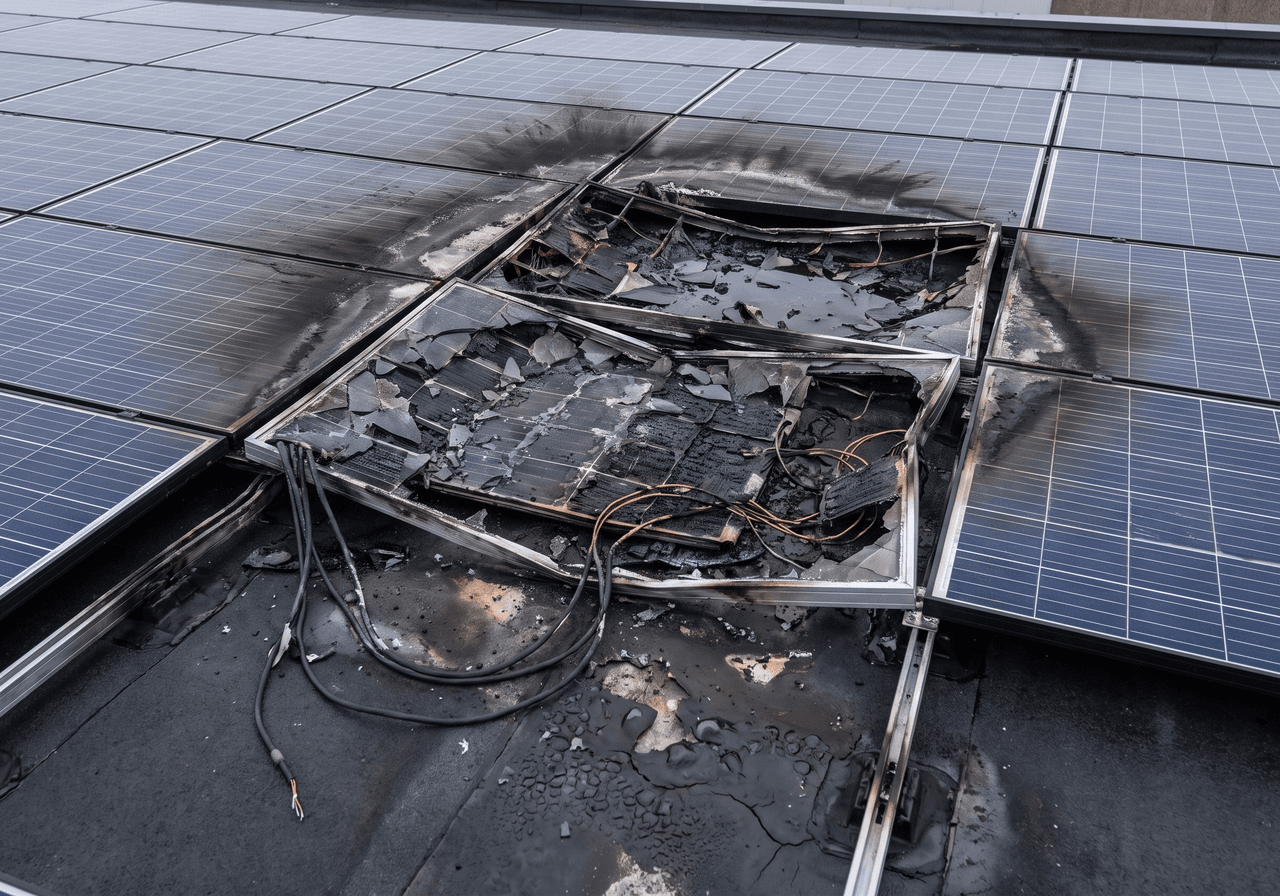
Typical damage patterns
- Arc fault at DC connectors due to ageing, installation errors or contact wear
- Fire inside the inverter or the combiner box
- Thermal runaway of a battery storage unit
- Fire spread across combustible roofing or missing separation between ignition source and fire load
- Insulation faults and cable fire on the DC side after animal bite or mechanical damage
- Hot spots on modules resulting in fire
Questions of evidence we answer
- Did the fire originate in the PV system or in another appliance in the building?
- Which component triggered the fire, and was an installation or maintenance defect involved?
- Can a natural event such as lightning or storm be excluded as the cause?
- Is there a product defect, and is recourse against the manufacturer or installer possible?
- Are the restoration and remediation costs damage-related and reasonable?
How we examine
Systematic exclusion logic: every conceivable cause is examined individually and ruled out with reasons until the most probable one remains.
- Site inspection with documentation of the fire progression, securing of exhibits
- Evaluation of inverter monitoring and log data up to the moment of failure
- Exclusion of external causes via lightning location and weather data
- Visual inspection and partial disassembly of connectors, comparison with undamaged reference parts
- Micro-focus X-ray analysis of the electronics and laboratory examination of the cabling
- Assessment of maintenance condition and installation against DIN VDE 0100-712 and DIN VDE 0105-100
- Cost review distinguishing remediation, replacement and items not related to the loss
The result
The report names the point of origin, the ignition mechanism and the causal chain. Every alternative ignition source is ruled out individually. You receive a clear statement on recourse and on the reasonableness of the costs.
Frequently asked questions
What must happen to the system after the fire?
Do not dispose of or dismantle anything before we have secured the exhibits. Components disposed of prematurely cannot be examined, and the cause remains open.
Can you work with the fire brigade and police investigators?
Yes. We coordinate with fire investigators, incorporate their findings into our assessment and add the technical analysis of the system.
Do you also examine battery storage units after a fire?
Yes. We examine lithium-ion storage in the laboratory, including X-ray inspection of the cells and assessment of pressure relief according to DIN EN 62133.
Enquiry about this type of loss
A few key facts, and we get back to you on the same working day with an assessment of how to proceed.
Do you have a case?
Call us or send us the claim notification with your questions of evidence. We get back to you the same working day.