Expert Reports on Inverter Damage
Wear, surge, moisture or product defect? We dismantle the unit, determine the component age and attribute the failure.
The inverter is the component with the shortest service life in a PV system. Once the customary service life is exceeded, electrolytic capacitors and power semiconductors are the most frequent cause of failure. We tell you whether an insured event or an operational failure has occurred, and what replacement costs at current value.
Typical damage patterns
- Failure after ageing of electrolytic capacitors and power semiconductors
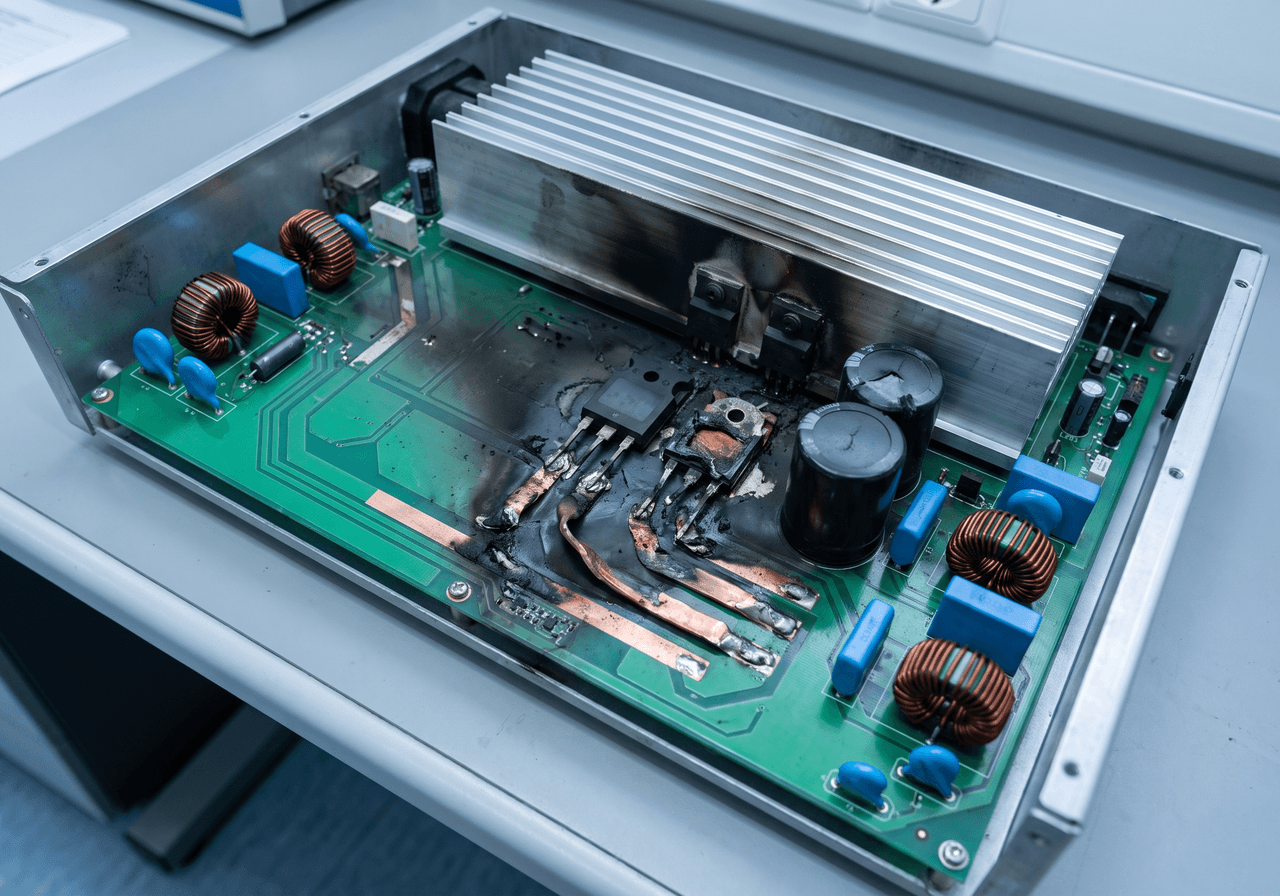
- Surge damage with burst components and vaporised conductor tracks
- Moisture ingress due to defective sealing, including micro-inverters
- Thermal wear due to high packing density in inverter stations
- Connector defect with consequential damage to the power supply board
- Unjustified complete replacement despite a localised finding
Questions of evidence we answer
- Is this a lightning-related surge damage or an age- and wear-related operational failure?
- Is the unit beyond its customary service life, and what current value results?
- Is the demanded complete replacement technically necessary, or is repair possible?
- Is this a manufacturing defect with product liability of the manufacturer?
- How high is the yield loss during the downtime?
How we examine
Systematic exclusion logic: every conceivable cause is examined individually and ruled out with reasons until the most probable one remains.
- External visual inspection of the unit for damage and external influences
- Request and disassembly of the damaged unit, age determination via component date codes
- Visual inspection of the boards for soot marks, burst components and vaporised conductor tracks
- Micro-focus X-ray examination of the semiconductors to exclude hidden surge damage
- Evaluation of lightning location data for the site and period
- Functional test and comparison of the unit's age with the customary service life
- Review of the repair invoice or quotation against market rates, current value per valuation guideline
The result
The report attributes the failure unambiguously and substantiates the exclusion of the remaining causes. You receive the current value per the valuation guideline for ICT systems and electronics, and the yield loss calculated from the comparison of feed-in quantities.
Frequently asked questions
Does the defective unit have to be sent in?
Yes, if the cause is disputed. We have the unit requested and examine it in the laboratory. Without the damaged item, only an assessment based on the file remains.
How long does an inverter last?
The customary service life is around eight years. Failures after that are usually wear, unless the trace pattern shows otherwise.
Do you also examine central inverters in solar parks?
Yes. We have examined central inverters and inverter stations at ground-mounted plants, including as court-appointed experts.
Enquiry about this type of loss
A few key facts, and we get back to you on the same working day with an assessment of how to proceed.
Do you have a case?
Call us or send us the claim notification with your questions of evidence. We get back to you the same working day.